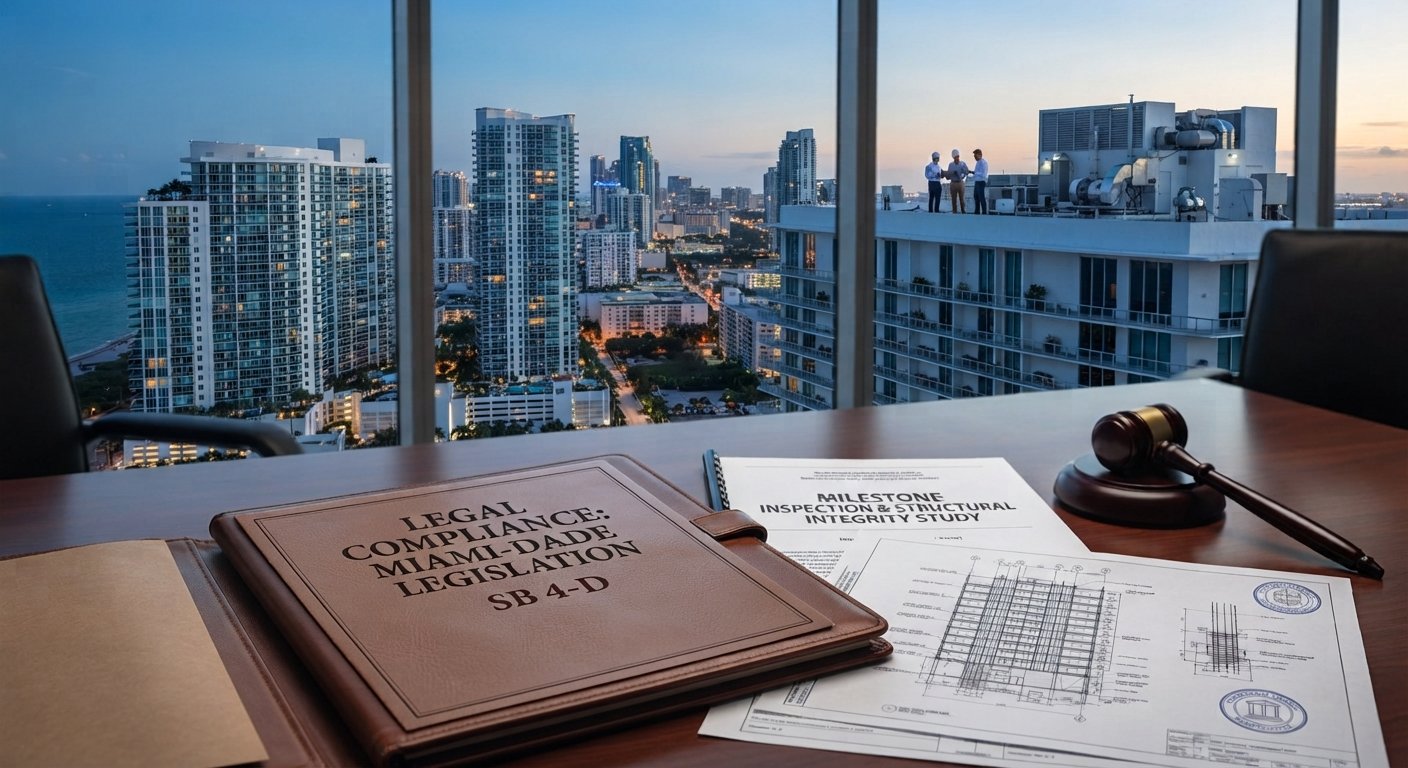
The collapse of Champlain Towers South in Surfside accelerated one of the most consequential changes in Florida condominium law in decades. The civil settlements arising from the tragedy provided financial compensation to victims and families, but the long-term legal legacy extends far beyond the courtroom.
Through Senate Bill 4-D and subsequent amendments to Florida condominium law, condominium associations now face a more formal system of structural inspections, reserve planning, repair obligations, and transaction disclosures. For qualifying condominium communities across Miami-Dade County, structural compliance is no longer simply a question of maintenance priorities or annual budgeting. It is a statutory governance obligation with serious implications for association boards, unit owners, buyers, lenders, and the marketability and financing of affected properties.
From Deferred Maintenance to Mandatory Compliance
For years, many Florida condominium associations struggled with the practical and political pressures of aging buildings. Rising insurance costs, owner resistance to higher assessments, and the historical ability to waive or reduce some reserve contributions often encouraged boards to postpone expensive capital projects.
That approach has changed substantially.
Florida law now requires many condominium and cooperative buildings to complete milestone inspections and structural integrity reserve studies, commonly called SIRS. These requirements are designed to identify structural deterioration earlier, establish a more disciplined reserve-funding process, and reduce the likelihood that critical repair work will be deferred because of short-term financial or political pressure. The state's milestone-inspection requirements and SIRS requirements now form an important part of condominium governance.
The legal stakes are particularly important for board members. Florida law expressly provides that a willful and knowing failure by an association officer or director to obtain a required milestone inspection, or to complete a required SIRS, is a breach of that person's fiduciary relationship to the unit owners.
That does not mean every maintenance delay or underfunded budget automatically creates personal liability. Liability depends on the facts, the association's governing documents, the applicable statutory duties, the board's conduct, causation, available defenses, and the nature of any claim. But the current law gives boards far less discretion to disregard mandatory structural-safety processes.
Milestone Inspections for Aging Miami-Dade Condos
Florida's milestone-inspection law generally applies to condominium and cooperative buildings that are three or more habitable stories in height. The requirement is not limited to high-rise towers; many mid-rise and other multi-story residential buildings may fall within the law's scope.
A qualifying building generally must receive its first milestone inspection by December 31 of the year it reaches 30 years of age, measured from the date of its certificate of occupancy. Subsequent milestone inspections generally are required every 10 years.
A local enforcement agency may require the first inspection at 25 years when local conditions justify an earlier review. Proximity to salt water is one factor that may support an earlier inspection schedule, a consideration particularly relevant in coastal communities throughout Miami-Dade County. The applicable Florida milestone-inspection law establishes these inspection requirements and procedures.
The inspection process has two phases:
- Phase 1 is a visual examination of the building's structural components by a Florida-licensed architect or engineer.
- Phase 2 is required if the Phase 1 inspection identifies signs of substantial structural deterioration. This phase may involve a more detailed evaluation, including destructive or nondestructive testing where appropriate.
The inspection report must address material findings, unsafe or dangerous conditions, recommended repairs, preventive repairs, and any need for further investigation.
When a Phase 2 report identifies substantial structural deterioration, the applicable county or municipal government must have an ordinance requiring the association or other responsible owner to schedule or commence repairs within a specified timeframe after the local enforcement agency receives the report. In all events, required repairs must be commenced within 365 days after the local enforcement agency receives the Phase 2 report.
For associations, this establishes a more formal progression from an engineer's findings to action by the board. A serious report cannot simply be set aside while an association waits for a more convenient budget cycle.
SIRS and the End of Broad Reserve Waivers
A milestone inspection focuses on the building's structural condition. A structural integrity reserve study serves a different, but closely related, purpose: it helps determine the reserve funding needed for future repair or replacement of major building components.
For covered associations, a SIRS must examine at least the following categories:
- Roof
- Structural components, including load-bearing walls and primary structural systems
- Fireproofing and fire-protection systems
- Plumbing systems
- Electrical systems
- Waterproofing and exterior painting
- Windows and exterior doors
- Other qualifying high-cost items whose failure could negatively affect the listed systems
The reserve implications are substantial. For associations required to obtain a SIRS, unit owners generally may not vote to waive or reduce reserve funding for the required SIRS components. Instead, the reserve amount for covered SIRS items must be based on the findings and recommendations of the association's most recent SIRS, subject to limited statutory exceptions and funding rules. The applicable Florida reserve requirements establish the restrictions on reducing or eliminating these reserves.
This does not necessarily mean every association must immediately accumulate all projected repair costs in cash. Florida law permits qualifying reserve obligations to be funded through regular assessments, special assessments, lines of credit, or loans, provided the association follows the applicable statutory requirements and approval procedures.
The practical result, however, is clear: boards can no longer rely on broad owner votes to defer reserve funding for core structural components simply because higher assessments are unpopular. Owners who fall behind on those higher assessments face real consequences, including the possibility that the association forecloses on their unit.
Board Duties and Insurance Considerations
Board members now oversee a more structured compliance process, including ensuring that required inspections and reserve studies are obtained, responding appropriately to engineering findings, communicating required information to owners, and addressing repair and funding obligations when they arise.
The greatest legal risk arises when officers or directors knowingly disregard specific statutory duties. Florida law expressly identifies the willful and knowing failure to obtain a required milestone inspection or complete a required SIRS as a breach of the officer's or director's fiduciary relationship to unit owners.
Other decisions remain fact-dependent. A board's handling of repairs, assessments, insurance, vendor selection, engineering recommendations, and reserve funding may be challenged by owners, but an unfavorable financial outcome does not by itself establish personal liability.
Directors and officers liability insurance remains an important protection for condominium board members, but boards should not assume that every claim will be covered. Coverage depends on the specific policy language, exclusions, notice requirements, prior-knowledge provisions, policy limits, and the facts of the claim.
Claims involving alleged misconduct, known building conditions, statutory noncompliance, or a failure to act after an engineering report may raise difficult coverage questions. Boards should review D&O policies with qualified insurance and legal professionals before a structural issue develops into a dispute.
The prudent approach is not to treat insurance as a substitute for compliance. Insurance may help with defense costs or covered claims, but it does not eliminate the need for timely inspections, complete records, informed board decisions, and transparent communication with owners.
Transaction Disclosures and Buyer Due Diligence
The post-Surfside regulatory framework has also changed condominium transactions throughout Miami-Dade County.
In covered resale transactions, Florida law requires sellers to provide purchasers with specified condominium records. Depending on the building and available records, those materials may include milestone-inspection summaries, the most recent SIRS, or a statement that a SIRS has not yet been completed, along with financial and governance documents required under Florida condominium law.
Contracts also require prescribed notices and buyer acknowledgment language concerning available milestone-inspection reports, turnover inspection reports, and structural integrity reserve studies. Florida's condominium disclosure statute sets out these requirements.
For buyers, these records have become essential due-diligence materials. A buyer evaluating an older condominium should closely examine:
- Whether the building is subject to milestone-inspection requirements
- The date of the most recent milestone inspection and whether a Phase 2 inspection occurred
- Whether substantial structural deterioration was identified
- The most recent SIRS and projected reserve needs
- Current reserve balances and the association's funding method
- Pending or approved special assessments
- Required repairs and projected completion dates
- Insurance deductibles, renewal costs, and coverage limitations
- Litigation, lender restrictions, and association borrowing
For sellers, associations, managers, and real estate professionals, complete and timely documentation matters. Missing reports, unresolved repair issues, or unclear reserve obligations can delay a sale, weaken buyer confidence, and complicate financing.
Financing and Market Consequences
The legal effects of the Surfside-era reforms extend into the mortgage market.
Fannie Mae, Freddie Mac, portfolio lenders, and other mortgage providers may evaluate condominium projects for safety concerns, deferred maintenance, major special assessments, reserve funding, insurance, litigation, and required repairs. Fannie Mae's project review standards address matters including project reserves and deferred maintenance, while Freddie Mac's condominium project requirements address project eligibility and critical-repair issues.
A project with unresolved structural concerns or substantial pending expenses may face a more difficult project review, which can reduce financing options for prospective buyers.
The term "non-warrantable" is commonly used in the lending industry to describe condominium projects that do not meet certain conventional financing standards. It is not, however, a statutory label created by Florida's condominium-safety laws.
Whether a project is eligible for financing depends on the lender, loan program, project-review process, condition of the building, reserve and assessment information, repair status, insurance, and other underwriting factors.
In practical terms, buildings with current engineering reports, completed repairs, transparent budgets, adequate reserves, and clear compliance records may be easier to market than communities facing unresolved structural questions or large anticipated assessments.
A New Standard for Miami-Dade Condos
The post-Surfside legal framework represents a decisive departure from the period when associations could more easily defer critical structural obligations in the name of lower monthly assessments.
For covered condominium communities in Miami-Dade County, milestone inspections, SIRS-based reserve planning, repair obligations, and statutory disclosures are now central parts of association governance. Boards must balance affordability concerns with mandatory safety processes, professional engineering advice, and the long-term condition of the property.
The central lesson is not that every aging building is unsafe or that every board member faces automatic personal liability. It is that condominium governance now demands earlier action, better documentation, more transparent disclosures, and less tolerance for ignoring mandatory structural-safety requirements.
Condominium associations, board members, owners, buyers, and sellers should consult qualified Florida condominium counsel, licensed engineers, insurance professionals, and other appropriate advisers regarding their specific circumstances.