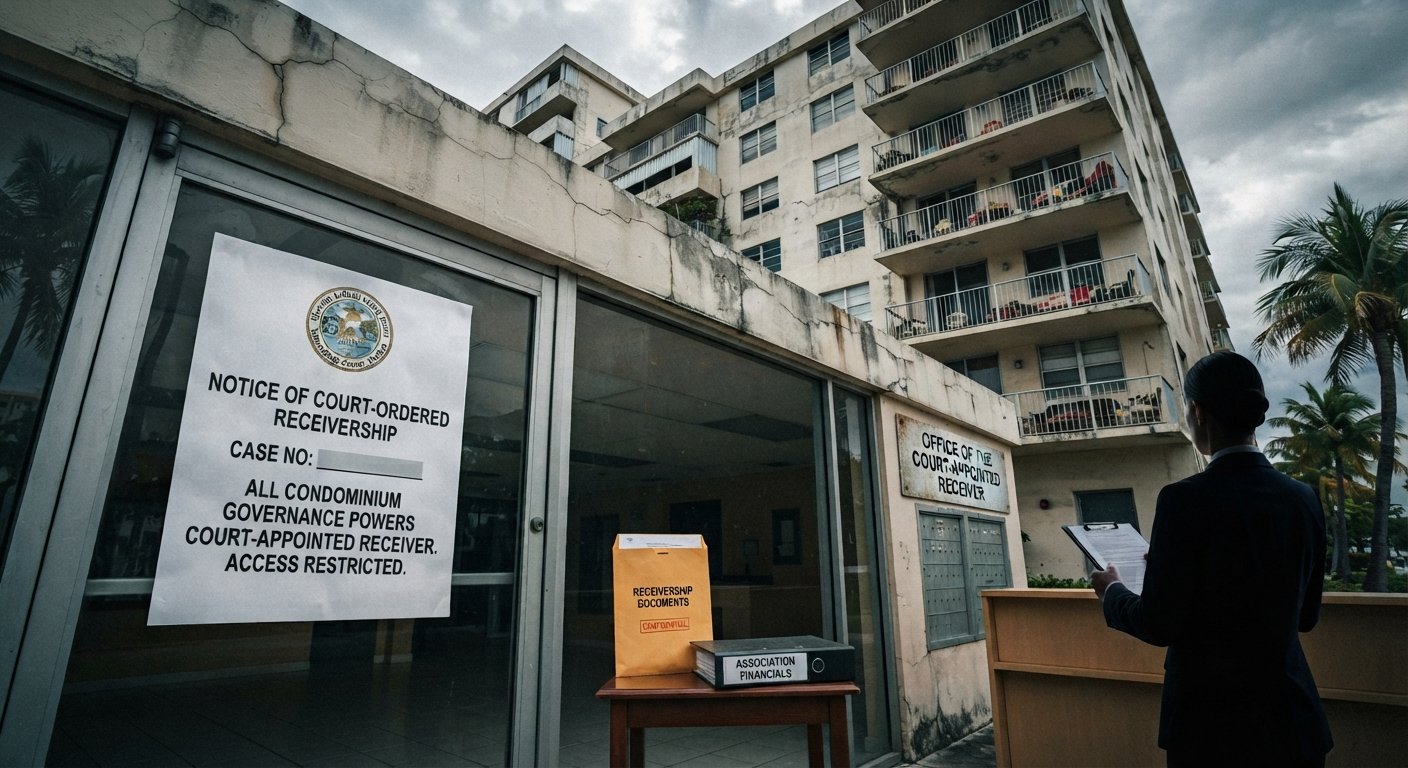
A Florida condominium association is supposed to be governed by its board of administration, with directors elected or appointed according to the condominium's governing documents and Florida law. But what happens when a board can no longer function because too many vacancies remain unfilled?
In certain circumstances, Florida law allows a unit owner to ask a circuit court to appoint a receiver to manage the association's affairs. This is known as judicial receivership.
For South Florida condominium owners, the distinction between receivership and condominium termination is particularly important. A receivership is primarily a governance remedy. Termination, by contrast, ends the condominium form of ownership through a separate statutory process.
What Is a Judicial Receivership?
Florida Statutes § 718.1124 specifically addresses a situation in which a condominium association has failed to fill enough vacancies on its board of administration to establish a quorum under the association's bylaws.
Under the receivership statute, § 718.1124, a unit owner may provide the required notice of an intent to apply to the circuit court for appointment of a receiver.
This is an important distinction.
For the board-vacancy receivership specifically authorized by § 718.1124, the key statutory issue is not simply financial distress, deferred maintenance, expensive insurance, or disagreement among owners. The issue is the association's failure to fill enough board vacancies to establish a quorum after the required notice and opportunity to cure.
The receiver is not simply a consultant hired by the association. The receiver operates under judicial authority.
Section 718.1124 is an important statutory board-vacancy remedy, but a receiver’s authority and purpose can differ when appointment arises under another statute or court proceeding. The applicable statute and the court’s appointment order matter.
Why Are Board Vacancies Such a Serious Issue?
A condominium association needs a functioning governing structure to make decisions, approve expenditures, maintain common elements, address contracts, deal with insurance, administer assessments, and handle other association business.
When there are too few directors to establish a quorum, the association can face practical difficulties making decisions that require board action.
That can become especially significant when a condominium is dealing with expensive repairs, insurance problems, structural issues, reserve funding, or other major obligations.
A governance problem does not automatically mean that a building is physically unsound or financially insolvent. But prolonged inability to operate the association can make an existing problem substantially harder to manage.
Milestone Inspections Can Expose the Scope of a Problem
Florida's condominium laws have placed increased emphasis on the structural condition of aging buildings.
Under Florida's milestone inspection law, § 553.899, qualifying residential condominium and cooperative buildings that are three habitable stories or more generally must undergo a milestone inspection by December 31 of the year in which the building reaches 30 years of age, and every 10 years thereafter.
In certain circumstances, a local enforcement agency may require the first inspection at 25 years based on local conditions, including proximity to saltwater. The statute establishes a statewide framework while allowing the earlier local deadline when the statutory conditions are met.
A milestone inspection is intended to evaluate structural components and identify substantial structural deterioration. A Phase Two inspection is required when the Phase One inspection identifies substantial structural deterioration.
These inspections do not themselves create a receivership. However, they can identify substantial repair or maintenance issues that an association must address.
For a condominium already struggling with board vacancies, major inspection findings can make the consequences of governance problems more serious.
Insurance Can Add Another Layer of Financial Pressure
Insurance is another major concern for Florida condominium associations, particularly in South Florida.
Premiums, deductibles, coverage requirements, claims, property conditions, and the availability of insurance can all affect an association's finances. At the same time, an association may face substantial maintenance, repair, reserve, and inspection obligations.
These pressures can make effective board governance particularly important.
But expensive insurance or financial strain alone does not create the specific receivership remedy provided by § 718.1124. The statutory board-vacancy receivership procedure focuses on the association's inability to fill enough board positions to establish a quorum.
Three Signs a Condominium May Be Heading Toward a Receivership Problem
There are several practical warning signs that condominium governance may be deteriorating.
1. The Board Cannot Maintain a Quorum
This is the most important issue under § 718.1124.
If vacancies leave the board without enough directors to establish a quorum under the bylaws, the association may eventually face the statutory receivership procedure.
2. Owners Are Unwilling to Serve
A condominium association cannot rely on an effective board if owners are consistently unwilling or unable to fill vacant positions.
A shortage of willing directors can become particularly serious when the association is dealing with complicated financial, structural, insurance, or legal matters.
3. Major Decisions Are Repeatedly Deferred
Repeatedly postponing major decisions can be a warning sign that an association's governance structure is under strain.
However, this should not be confused with the statutory trigger for the § 718.1124 receivership process. A board may have serious disagreements or delayed projects without necessarily meeting the statute's specific requirements for appointment of a receiver.
What Happens Before a Receiver Is Appointed?
A receiver is not simply appointed because one owner is unhappy with the board.
Section 718.1124 establishes a notice and cure procedure.
The required notice informs the association and owners that the unit owner intends to seek appointment of a receiver because the association has failed to fill enough board vacancies to establish a quorum.
The association generally has 30 days after the statutory notice is sent or posted, whichever is later, to fill the vacancies before the owner may proceed with the petition.
The statutory procedure also establishes specific requirements concerning how the notice is provided.
If the vacancies are not filled within the statutory period, the unit owner may proceed with a petition to the circuit court.
The court then determines whether a receiver should be appointed under the circumstances.
What Happens When a Receiver Is Appointed?
A receiver appointed under § 718.1124 has the powers and duties of a duly constituted board of administration.
That means receivership is fundamentally about restoring the association's ability to function.
The receiver operates under the authority of the court rather than simply taking instructions from individual unit owners.
The receiver's authority is also not unlimited. The receiver remains subject to applicable Florida law, the condominium's declaration and governing documents, and the court's order.
The receiver generally remains in place until the association fills enough board vacancies to establish a quorum and the court relieves the receiver of the appointment.
In practical terms, receivership changes who is managing the association's affairs while the underlying condominium ownership remains in place.
Can a Receiver Impose Assessments?
A receiver appointed under § 718.1124 has the powers and duties of a duly constituted board.
That can include exercising lawful association powers that would ordinarily belong to the board, including matters involving the association's finances and assessments.
However, this does not mean that a receiver has unlimited authority to impose any assessment for any purpose.
The receiver remains subject to Florida law, the governing documents, and the court's order. The particular authority available to a receiver should therefore be examined in the context of the specific case.
Who Pays for the Receiver?
The cost of receivership is an important consideration for condominium owners.
Under § 718.1124, the association is responsible for the receiver's salary, court costs, and attorney's fees.
That means receivership can create another financial obligation for an association that may already be under financial pressure.
The statute expressly addresses these costs rather than treating the receiver as a free service provided by the court.
What About Existing Litigation?
Receivership does not automatically erase existing litigation involving the condominium association.
An association may have pending lawsuits, insurance disputes, construction claims, collection matters, or other legal proceedings when a receiver is appointed.
The effect of the appointment on particular litigation depends on the circumstances and the court's orders.
Owners should not assume that the appointment of a receiver automatically resolves the association's existing legal problems.
Does a Receiver Take Away the Owners' Units?
No. Receivership under § 718.1124 does not, by itself, transfer ownership of condominium units to the receiver.
The receiver is placed in control of specified association affairs. The individual unit owners continue to own their condominium parcels.
This distinction is one of the most important differences between receivership and condominium termination.
Receivership changes the management structure. Termination changes the legal structure of the property.
Judicial Receivership vs. Condominium Termination
These two concepts should not be confused.
A judicial receivership can address a condominium association that cannot properly function through its ordinary board structure.
A condominium termination ends the condominium form of ownership through a separate legal process.
Florida's termination statute, § 718.117, contains multiple statutory routes for termination, including circumstances involving economic waste or situations in which it becomes impossible to operate or reconstruct the condominium because of land-use laws or regulations.
Termination can ultimately involve the sale or other disposition of condominium property and distribution of proceeds according to the statutory process and applicable plan of termination.
Receivership, by contrast, does not automatically mean that the condominium will be sold or terminated.
Florida's Condominium Termination Law Is a Separate Process
Section 718.117 provides a detailed procedure for terminating a condominium.
For example, the statute provides a mechanism for termination based on economic waste or impossibility when the statutory conditions are satisfied.
It also provides a separate optional termination procedure. For a residential association proceeding under that route, the plan generally must receive approval from at least 80 percent of the total voting interests. If 5 percent or more of the total voting interests reject the plan through a negative vote or written objections, the plan may not proceed under that provision.
The precise requirements depend on the applicable subsection, the condominium's governing documents, the circumstances involved, and whether statutory exceptions apply.
This is another reason why it is important not to describe receivership and termination as interchangeable concepts.
Could Receivership Eventually Lead to Termination?
It could, but there is no automatic connection between the two.
Consider a hypothetical condominium with serious governance problems. A receiver is appointed because the association cannot fill enough board vacancies to establish a quorum.
The receiver may then help restore functioning management, address outstanding financial obligations, organize records, deal with contracts, and exercise the association's lawful powers.
During that process, the association's financial and physical condition may become clearer.
If the property is facing severe structural problems, extraordinary repair costs, economic waste, or other circumstances covered by Florida's termination statute, the owners or other authorized parties may separately consider whether termination is appropriate.
The sequence could therefore look something like:
Governance crisis → judicial intervention → financial and physical assessment → decision about the property's future → possible continuation, rehabilitation, sale, or termination.
But receivership itself does not require the final step.
Receivership Does Not Automatically Mean a Building Is Beyond Saving
A receivership can sound dramatic because it involves court intervention.
But the appointment of a receiver should not automatically be interpreted as a declaration that a condominium building is unsafe, worthless, or beyond repair.
The statutory board-vacancy receivership procedure is aimed at a governance problem: the association has failed to fill enough vacancies to establish a quorum.
A building can have serious physical or financial problems and still have a functioning board. Conversely, a condominium can have a governance crisis even when the physical property itself is not beyond repair.
Those are separate questions.
Why South Florida Condominiums Are Under Unusual Pressure
South Florida condominiums face a combination of factors that can make condominium governance especially demanding.
Many buildings are aging. Associations may have to address structural inspections, reserve requirements, major maintenance projects, insurance costs, hurricane exposure, and increasingly expensive building repairs.
The statutory milestone-inspection requirements are one part of this broader environment.
For qualifying buildings, the inspection process can bring significant structural issues to the attention of owners and associations. Florida's condominium laws also contain requirements concerning structural integrity reserve studies and the funding of certain long-term repairs.
That makes a functioning board especially important. A condominium association may need to respond promptly to engineering findings, arrange professional evaluations, obtain bids, approve contracts, communicate with owners, prepare budgets, and determine lawful funding methods.
What Should Owners Do?
Owners should not assume that receivership is either a disaster or a complete solution.
If board vacancies are preventing an association from functioning, owners should review the condominium's governing documents and the specific statutory procedures governing board vacancies, quorum, notice, and receivership.
Owners should also obtain accurate information about:
- The number of board vacancies and the quorum requirement under the bylaws
- The association’s financial condition, operating budget, and reserves
- Insurance coverage, deductibles, renewals, and claims
- Engineering reports, milestone inspections, and repair recommendations
- Existing contracts, unpaid obligations, assessments, and litigation
A Florida attorney experienced in condominium and community-association law can evaluate whether the association should attempt to fill vacancies through its regular procedures, seek professional management assistance, address a particular dispute, or consider judicial relief.
Frequently Asked Questions
Is receivership the same as condominium termination?
No. Receivership is a court-supervised management or administration remedy. Condominium termination is a separate statutory process for ending the condominium form of ownership.
Can a Florida condo owner request a receiver?
In certain circumstances, yes. Florida Statutes § 718.1124 provides a procedure for a unit owner to seek appointment of a receiver when board vacancies prevent the association from establishing a quorum, provided the statutory notice and other requirements are satisfied.
Does financial distress automatically qualify a condominium for receivership?
No. Financial distress, major repairs, deferred maintenance, expensive insurance, or large assessments do not alone satisfy the board-vacancy receivership requirements of § 718.1124. The statutory procedure focuses on the association’s failure to fill sufficient board vacancies to establish a quorum.
Does a receiver own the condominium?
No. A receiver does not become the owner of individual condominium units. The receiver administers association affairs within the authority granted by law and the court’s order.
Can a receiver impose assessments?
A receiver appointed under § 718.1124 generally has the powers and duties of a duly constituted board. That may include using the association’s lawful assessment authority, but the receiver remains subject to Florida law, the declaration and governing documents, and the court’s order.
Does receivership automatically mean the building will be sold?
No. Receivership does not automatically result in a sale or condominium termination.
Can a condominium be terminated after a receivership?
Possibly, but only through compliance with Florida’s separate condominium-termination law. Receivership does not itself trigger or authorize termination.
How long does a receivership last?
Under the board-vacancy procedure in § 718.1124, a receiver generally serves until the association fills enough board vacancies to establish a quorum and the court relieves the receiver. A receiver appointed under another legal authority may operate under different terms set by the relevant statute and court order.
Bottom Line
A Florida condominium receivership is best understood as a court-supervised response to a management or governance problem—not as a synonym for selling or terminating the condominium.
For the specific board-vacancy receivership authorized by § 718.1124, the central statutory issue is the association’s failure to fill enough board vacancies to establish a quorum after the required notice and opportunity to cure.
That distinction is particularly important in South Florida, where aging buildings can face structural-inspection requirements, reserve obligations, insurance pressures, construction-cost increases, and complex maintenance demands.
When a board can no longer function, judicial intervention may become necessary. But receivership is not necessarily the end of the condominium. It may provide a route to restore administration, manage pressing obligations, and return the association to ordinary owner governance.
If owners later determine that operating the condominium is no longer economically practical, condominium termination is a separate legal process governed by Florida Statutes § 718.117.