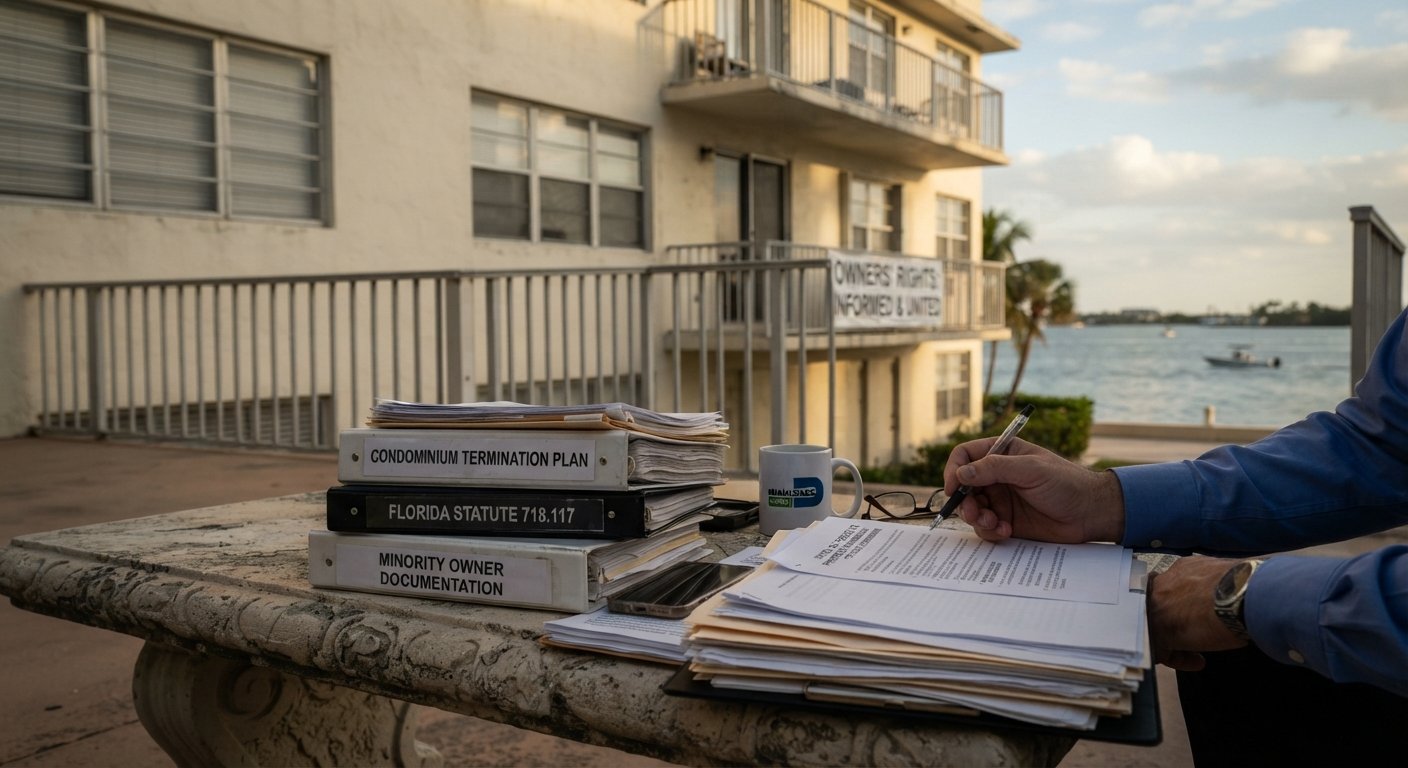
Across Miami‑Dade, Broward, and Palm Beach counties, coastal real estate is undergoing a major structural shift. Many aging buildings dating from the 1970s and 1980s condo booms now face a convergence of economic pressures: soaring insurance premiums, stricter recertification mandates, and deferred maintenance. For opportunistic developers and institutional buyers, these vulnerabilities create openings to acquire aging properties at a discount, end the condominium form of ownership, and redevelop the land.
While bulk buyouts and voluntary terminations can offer an exit for communities facing massive repair bills, they often bring financial and emotional strain to minority owners who want to stay. Understanding how Florida’s condo laws intersect with association rules is essential for anyone navigating these high‑stakes battles.
The Anatomy of a Florida Condominium Termination
A condominium termination ends the condominium form of ownership and initiates the process of liquidating the condominium property and winding up the association’s affairs. In Florida, these actions are governed by Section 718.117, which sets strict procedural hurdles and defines multiple termination paths.
Florida’s statute does not have a single “termination rule.” Two key mechanisms matter most for aging buildings:
- Economic waste or impossibility (§718.117(2)): Section 718.117(2) provides a termination mechanism based on economic waste or impossibility, subject to the statutory requirements.
- Optional termination (§718.117(3)): This is the “bulk buyout” path. For a standard optional termination, the statute requires approval by at least 80% of the total voting interests, provided that no more than 5% of the total voting interests reject the plan—but only if the declaration does not set a different threshold.
Treating the 80% figure as universal is a common mistake. Many older declarations require higher approval levels, and some still require unanimous consent for termination or for amendments affecting voting rights.
Understanding the Voting Thresholds and the 5 Percent Rule
A common flashpoint in Miami‑Dade buyouts is how votes are cast, counted, and contested. The statute requires that all voting interests be accounted for, and no interest can be arbitrarily suspended during a termination vote.
Under the optional‑termination procedure, if an investor group quietly acquires 80% or more of the units, they may hold the numerical majority to initiate a plan. For remaining owners, stopping the process hinges on the statutory rejection floor: if 5% or more of total voting interests formally reject the plan by negative vote or written objection, the effort is blocked and a new optional‑termination plan generally cannot be considered for 24 months.
This 5% rule is a clear statutory veto, not a “trap,” but organizing a defense still requires fast communication, solid legal guidance, and strict attention to deadlines.
In Miami‑Dade, the Third District Court of Appeal’s 2025 revised opinion in Avila v. Biscayne 21 is especially important. The court held that reducing a declaration’s termination threshold from 100% to 80% altered owners’ voting rights where the declaration required unanimous approval for amendments affecting voting rights. The Florida Supreme Court declined review in October 2025, leaving the Third DCA decision intact—a key point for owners in buildings with high original thresholds.
Fair Market Value Disputes and Appraisal Rights
When a termination moves forward, the battle often shifts from whether the property will sell to how much each unit is worth.
Under the statute, fair market value must be determined as of a date no earlier than 90 days before the plan is recorded, using an independent appraiser selected by the termination trustee. For long‑time residents—especially seniors or homestead owners—an appraisal managed by a bulk buyer’s trustee can sometimes undervalue the unit’s actual market value.
Owners who suspect bias can scrutinize the methodology. Disputes often center on comparable sales in hyper‑local markets like Brickell, Sunny Isles, or North Miami Beach. Importantly, the law defines fair market value using arms‑length sales in other condos and excludes distressed or wholesale bulk purchases from the comps.
For homesteaded (or qualifying owner‑occupied) units where the owner is current on assessments and other monetary obligations to the association as of the recording date, fair market value cannot be less than the original purchase price—a key protection beyond the 1% relocation payment.
Statutory Protections and Relocation Rights
Florida law builds specific safeguards into the termination framework to protect displaced residents. As explained in The Florida Bar’s overview, many of the strongest protections apply in the bulk‑owner optional‑termination scenario:
- Right of First Lease: If the former units are offered for lease to the public after termination, owners in occupancy immediately before recording have priority to lease their former unit for 12 months on the same terms as similar units, if they submit a written request within 90 days of recording.
- Relocation Payments: Where at least 80% of the voting interests are owned by a bulk owner at the time the plan is recorded, homesteaded owners who are current on dues are entitled to a relocation payment equal to 1% of the proceeds allocated to their unit, payable by the bulk owner no later than 10 days after vacating.
- Mortgage Satisfaction: If an owner is current on assessments and their mortgage as of the recording date, receiving their share of proceeds (or the outstanding balance, whichever is less) satisfies the first mortgage in full, which can protect qualifying owners from personal liability on the first mortgage.
Additional protections for minority owners include:
- Division of Condominiums review: For an optional termination plan, the Division has 45 days to identify deficiencies; otherwise, the filing is presumed accepted.
- Minority board representation: When a bulk owner controls the board, non‑bulk owners may elect at least one‑third of the board before approval of the termination plan.
When to Engage a Real Estate Litigator
Standard residential closing attorneys are rarely equipped to handle the complexities of a hostile condo termination. These disputes sit at the intersection of corporate strategy, property valuation, and administrative law, so owners facing an aggressive developer buyout need specialized counsel.
Condominium termination is also distinct from judicial receivership, which can arise when an association's board cannot function because of unfilled vacancies and lack of a quorum. See our guide to judicial receivership for Florida condominium associations for an explanation of that separate process.
If you’re a South Florida property owner facing an unexpected buyout vote, contested asset distribution, or unclear association notices, consulting a qualified professional is critical. Explore our directory to connect with local real estate litigation and property attorneys across Miami‑Dade and Broward who understand Florida community association law.