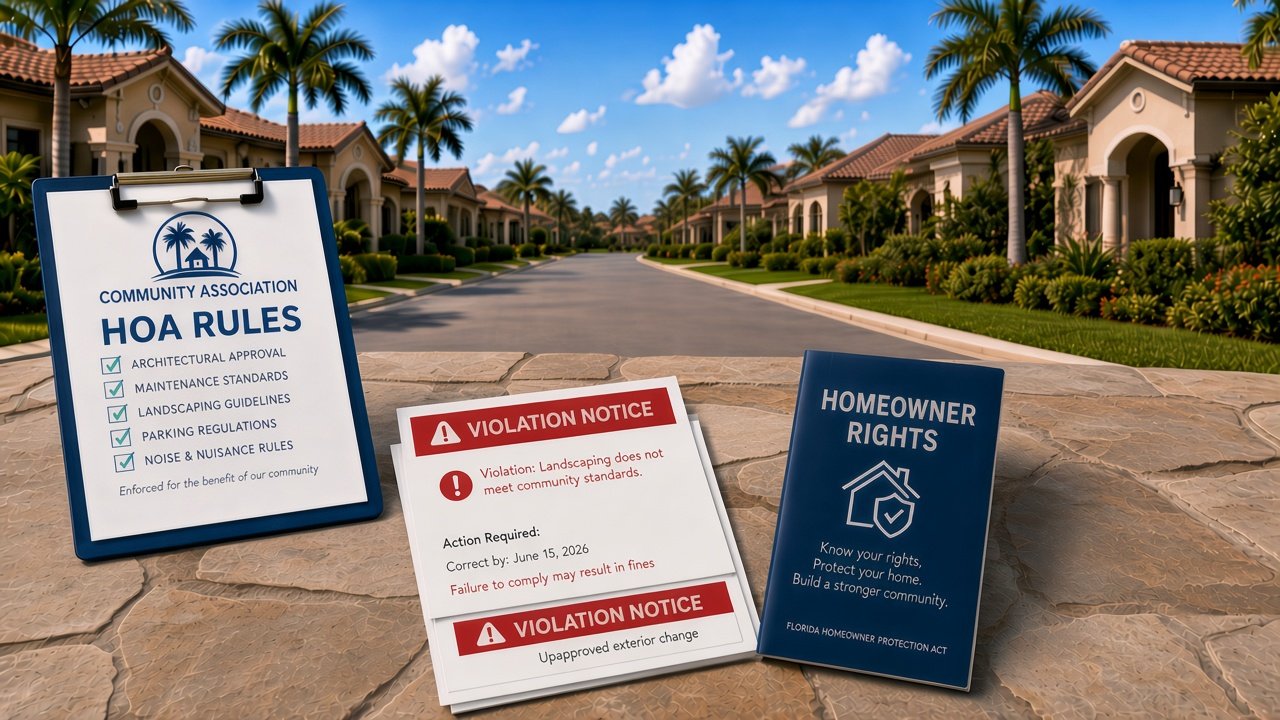
A disagreement between a Florida homeowner and a homeowners' association can begin with something relatively simple: a denied architectural request, a disputed rule violation, a request for association records, or a disagreement over how the community's governing documents should be interpreted.
Sometimes the dispute is more serious. An association may impose a substantial fine, pursue an assessment, refuse to provide records, take an action that an owner believes exceeds its authority, or become so dysfunctional that the association cannot maintain a functioning board.
When an HOA dispute cannot be resolved informally, the next step depends heavily on what kind of dispute has occurred.
Florida law provides different procedures for covenant-enforcement disputes, records disputes, fines, assessments, elections, recalls, and other conflicts. Some disputes are subject to presuit mediation. Others are excluded from that process or are governed by separate procedures.
Understanding those distinctions can help a homeowner determine what questions to investigate before escalating a dispute.
Start With the Governing Documents
Florida homeowners' associations are governed by Chapter 720 of the Florida Statutes as well as the community's governing documents and association rules. The Florida HOA statutes provide the statutory framework for homeowners' associations.
Section 720.305 provides that association members, their tenants, guests and invitees, and the association itself must comply with Chapter 720, the governing documents, and the association's rules. The statute also permits an association or member to bring an action at law or in equity to address an alleged failure or refusal to comply with those requirements.
The starting point in many HOA disputes is not simply, "What does Florida law say?"
It is:
What do the governing documents say, and does Florida law limit or supplement those provisions?
The declaration of covenants, bylaws, rules, architectural standards, amendments, meeting notices, correspondence, and other records may all be relevant.
For example, a homeowner challenging an architectural decision may need to examine the authority granted to the association in the declaration. Florida's architectural-control statute provides that an association's authority to review or approve improvements must be specifically stated or reasonably inferred from the declaration or authorized published guidelines and standards. Those standards must also be applied reasonably and equitably.
That is different from a dispute over an unpaid assessment, a records request, the collection of a fine, or an election.
Not All HOA Disputes Follow the Same Procedure
One of the most important things for a homeowner to understand is that there is no single procedure called "the Florida HOA dispute process."
The legal route can change depending on the subject of the dispute.
Under Florida's HOA dispute-resolution statute, certain disputes between an association and a parcel owner must be the subject of a demand for presuit mediation before the dispute is filed in court. The statute identifies disputes involving the use of or changes to a parcel or common areas, covenant enforcement, amendments to association documents, specified board and committee meetings, membership meetings other than election meetings, and access to official association records.
But the same statute specifically excludes the collection of an assessment, fine, or other financial obligation claimed to be due from its presuit-mediation category. Election and recall disputes are also subject to separate procedures.
That distinction matters.
A dispute about whether a fine was properly noticed or imposed is not necessarily the same thing as the association's effort to collect a fine that it claims is already due. Depending on the nature of the dispute and the remedy being sought, the underlying disagreement may overlap with covenant enforcement or another category covered by § 720.311.
The important point is that a homeowner should not assume that every dispute involving a fine or assessment automatically falls inside—or outside—the mediation requirement.
Step One: Identify the Actual Dispute
Before deciding what to do, it can be useful to reduce the conflict to a specific legal question.
For example:
"The HOA is violating my rights" is too broad to identify a procedure.
Compare that with:
- The HOA denied my request to install a permitted improvement.
- The association claims my property violates a covenant.
- The HOA imposed a fine without following the required procedure.
- The association refused to provide records I requested.
- The board is refusing to hold a required meeting.
- The association is attempting to enforce a restriction that I believe is not authorized.
- The HOA is demanding an assessment that I dispute.
- The board has lost enough directors that it cannot establish a quorum.
- I believe an association election was improperly conducted.
Each presents a different legal issue.
That is why a homeowner may want to identify the specific action or failure to act, the governing-document provision involved, the applicable statute, and the remedy being sought before sending a demand or filing anything in court.
When Is Presuit Mediation Required?
For disputes covered by § 720.311, Florida law establishes a presuit mediation process.
The statute requires an aggrieved party to serve a written demand to participate in mediation before filing the covered dispute in court. The demand must substantially follow the statutory form and identify the nature of the dispute and the authority supporting the alleged violation.
The statutory demand also has specific service requirements. It generally must be sent by certified mail, return receipt requested, with an additional copy sent by regular first-class mail to the address of the responding party as it appears in the association's records. The responding party generally has 20 days from the date of mailing to serve a written response.
The parties generally share the mediation costs equally unless they agree otherwise. If the mediation session cannot be scheduled and conducted within 90 days after the offer to participate in mediation was filed, an impasse is deemed to have occurred unless both parties agree to extend the deadline.
The process is intended to give the parties an opportunity to resolve the dispute without proceeding directly to litigation.
What If the Other Side Does Not Participate?
Section 720.311 addresses several circumstances that can constitute an impasse, including failure to respond to the demand, failure to agree upon a mediator, failure to pay required mediation costs, or failure to appear at the scheduled mediation.
The statute also provides an important consequence for a party that fails or refuses to participate in the entire mediation process: that party may be unable to recover attorney's fees and costs in subsequent litigation relating to the dispute.
That makes the mediation procedure more than a technical preliminary step.
A homeowner considering litigation should determine whether § 720.311 applies and, if it does, whether the statutory process has been properly completed.
What Happens If Mediation Does Not Resolve the Dispute?
Presuit mediation does not necessarily end the matter.
If mediation does not resolve all of the issues, the parties may file the unresolved dispute in a court of competent jurisdiction or agree to binding or nonbinding arbitration under the applicable procedures. If the parties do not agree to arbitration after an unsuccessful mediation, either party may file the dispute in court.
This creates an important distinction between participating in mediation and settling the dispute.
Mediation does not require either side to accept the other's position. If the parties cannot reach an agreement, the unresolved issues can continue through another legal process.
HOA Fines Have Specific Procedural Requirements
Fines are an area where homeowners can easily confuse the underlying violation with the procedure used to impose a fine.
Under Florida's HOA fining statute, an association may levy reasonable fines for violations of the declaration, bylaws, or reasonable association rules, subject to statutory requirements. A fine generally may not exceed $100 per violation. For a continuing violation, the board may levy a fine for each day the violation continues, but the fine may not exceed $1,000 in the aggregate unless otherwise provided in the governing documents. A fine of less than $1,000 may not become a lien against the parcel.
Before a board-imposed fine or suspension can generally be imposed, the board must provide at least 14 days' written notice of the owner's right to a hearing. The hearing must take place within 90 days after issuance of the notice and before a committee of at least three members who meet the statutory eligibility requirements.
The notice must include a description of the alleged violation, the specific action required to cure the violation if applicable, and the hearing date, location, and access information if the hearing is conducted electronically.
The committee's statutory role is to determine whether to approve or reject the fine or suspension levied by the board. If the committee, by majority vote, does not approve the proposed fine or suspension, it may not be imposed.
Within seven days after the hearing, the committee must provide written notice of its findings, including applicable fines or suspensions that it approved or rejected, how the violation may be cured if applicable, or the date by which an approved fine must be paid.
If the violation is cured before the hearing or in the manner specified in the required written notice, a fine or suspension may not be imposed.
If the violation is not cured and the committee approves the proposed fine or suspension, the committee must set a payment date at least 30 days after delivery of the written notice of its findings.
These procedural requirements can matter independently of whether the alleged violation actually occurred.
Fine Collection Is Different From Challenging the Fine
This distinction deserves special attention.
Section 720.311 excludes the collection of a fine claimed to be due from the category of disputes subject to its mandatory presuit mediation procedure.
That does not necessarily mean that every dispute concerning the validity of a fine is automatically outside mediation.
For example, a homeowner may dispute whether the underlying covenant was violated, whether the association had authority to enforce a particular restriction, or whether the required fining procedure was followed. Depending on the facts and the remedy sought, those issues may overlap with other categories of disputes identified in § 720.311.
The distinction between challenging the basis or procedure for a fine and collecting a fine claimed to be due is therefore important.
What If the Dispute Involves Association Records?
Access to official records is another area where an initially simple disagreement can become a formal legal dispute.
Florida Statute § 720.303 contains detailed provisions governing association powers, board meetings, official records, financial reporting, budgets, and related matters. The Florida official-records statute provides the specific rules governing access to association records.
As a general rule, official association records must be made available for inspection or copying within 10 business days after the board or its designee receives a written request from a parcel owner, subject to statutory exceptions and conditions. The records generally must be maintained within Florida for at least seven years.
The method of making the records available can vary. The statute permits associations to comply by making records available for inspection or copying, electronically through the Internet, or in electronic format that can be viewed and printed.
There is also a significant statutory consequence for a particular type of records request. If a parcel owner submits a written request by certified mail, return receipt requested, and the association does not provide access within 10 business days after receiving the request, the statute creates a rebuttable presumption that the association willfully failed to comply.
A member denied access may be entitled to actual damages or statutory minimum damages of $50 per calendar day for up to 10 days, with the calculation beginning on the 11th business day after receipt of the written request.
That makes the details of a records request important.
A homeowner who says, "My HOA won't give me the documents I requested," may need to determine:
- What specific records were requested?
- Are they official association records covered by Chapter 720?
- Was the request submitted in an appropriate manner?
- When did the association receive the request?
- Did the association provide access within the statutory period?
- Did the association assert a statutory exception?
- What remedy may be available?
Access to official records is specifically identified in § 720.311 as a category subject to presuit mediation.
Architectural Disputes Require a Close Look at the Declaration
Architectural-control disputes provide another example of why homeowners should not assume that an HOA has unlimited authority.
Section 720.3035 provides that an association's authority to review and approve improvements or enforce external-appearance standards must be specifically stated or reasonably inferred from the declaration or authorized published guidelines and standards. The association or architectural committee must also apply and enforce authorized standards reasonably and equitably.
The architectural-control provisions also address the information an association must provide when it denies an improvement request, including the rule or covenant relied upon and the specific aspect of the proposed improvement that does not conform.
Consider a homeowner who wants to install a fence, pool, addition, generator, solar equipment, or another exterior improvement.
The relevant questions may include:
- What does the declaration permit or prohibit?
- What authority does the architectural committee actually have?
- What standards have been adopted?
- Were those standards authorized?
- Were they applied consistently?
- Did the association explain the basis for the decision?
- Does another Florida statute affect the proposed improvement?
The answer can depend heavily on the particular property and governing documents.
Assessments Follow a Different Analysis
A dispute over an assessment deserves separate treatment.
Section 720.311 excludes the collection of an assessment claimed to be due from its presuit-mediation category.
Florida law separately addresses assessments and the collection of unpaid assessments in §§ 720.308 and 720.3085. The Florida assessment statutes provide rules concerning assessment obligations, payment, liens, and collection procedures.
A homeowner who disputes an assessment should therefore identify the precise basis for the disagreement.
For example, is the owner claiming:
- the assessment was not authorized?
- the amount was calculated incorrectly?
- the assessment was improperly allocated?
- required notice was not provided?
- the association failed to follow its governing documents?
- the owner disputes only the amount rather than the association's authority to impose it?
Those distinctions can affect the legal analysis and the available remedies.
Florida law permits an association, when authorized by the governing documents, to claim a lien against a parcel to secure payment of assessments and other amounts covered by § 720.3085. The statute also establishes requirements concerning claims of lien and their enforcement.
Because unpaid assessments can lead to liens and potentially further collection proceedings, an owner should not simply ignore an assessment while trying to determine whether it is valid.
Elections and Recalls Have Separate Procedures
Election and recall disputes are another important exception to the general mediation framework.
Under § 720.311, election and recall disputes are not eligible for presuit mediation. The statute provides that these disputes must instead be arbitrated by the Department of Business and Professional Regulation or filed in a court of competent jurisdiction.
Florida law separately addresses member meetings, voting, elections, amendments, and related procedures in § 720.306. The Florida HOA election provisions provide additional rules concerning voting and election procedures.
An owner challenging an election should therefore not assume that a standard presuit mediation demand is the appropriate first step.
Because election and recall disputes can involve specific statutory procedures, identifying the precise nature of the challenge is particularly important.
What If the HOA Board Cannot Function?
Florida law contains an unusual remedy for an HOA whose board vacancies prevent the board from establishing a quorum. A similar but separate receivership remedy applies to condominium associations under Florida law. See our guide to judicial receivership for a Florida condominium association for an explanation of how that process works for condominium owners.
Section 720.3053 provides a procedure under which a member may seek appointment of a receiver when the association has failed to fill board vacancies sufficient to constitute a quorum.
This is not an ordinary remedy for a disagreement between one homeowner and an HOA.
It addresses a more fundamental governance problem: the association does not have enough directors to function as a board.
Before filing, the member must give the notice required by § 720.3053 to the association and every member, including the statute's posting and delivery requirements. The notice must be provided at least 30 days before a receivership petition is filed. If the association does not fill enough vacancies to establish a quorum within 30 days after the required notice is posted and mailed or delivered, the member may proceed with the petition.
The statute authorizes the member to petition the circuit court within whose jurisdiction the association lies for appointment of a receiver. The Florida receivership statute establishes the applicable procedure and the receiver's role.
If a receiver is appointed, the receiver assumes the powers and duties of a duly constituted board and serves until the association fills enough vacancies to establish a quorum and the court relieves the receiver. The association is responsible for the receiver's salary, court costs, and attorney's fees.
This unusual remedy illustrates why an HOA dispute should not automatically be reduced to the question of whether the homeowner should "sue the HOA." Florida law contains different mechanisms for different problems.
What If the HOA Will Not Back Down?
A homeowner may eventually reach the point where informal communications have failed, an applicable presuit procedure has been completed, and the underlying dispute remains unresolved.
At that point, litigation may be available.
Section 720.305 allows actions at law or in equity to address alleged failures or refusals to comply with Chapter 720, governing documents, or association rules. The statute also provides for reasonable attorney's fees and costs to the prevailing party in qualifying litigation.
The Florida HOA remedies statute sets out these enforcement provisions.
That does not mean that every disagreement should become a lawsuit.
The important question is whether the homeowner has identified a legally enforceable right, obligation, restriction, or procedural violation and what remedy is available.
A homeowner can be unhappy with an association decision without necessarily having a legal claim that will overturn it. Conversely, an association may have enforcement authority while still being required to comply with Florida law, its declaration, and applicable procedural requirements.
Build the Record Before Escalating the Dispute
Regardless of the type of HOA dispute, documentation can become important if the matter eventually reaches mediation, arbitration, or court.
A homeowner may want to preserve:
- The declaration and amendments
- Bylaws and association rules
- Architectural guidelines
- Notices from the association
- Letters and emails
- Records requests and responses
- Photographs
- Meeting notices and minutes
- Fine notices
- Assessment statements
- Relevant contracts or reports
- Evidence of previous communications with the board or management company
It can also be useful to create a simple chronology.
For example:
January 5: Owner submits architectural request.
January 20: HOA denies request.
February 2: Owner asks for the provision supporting the denial.
February 15: HOA responds.
March 1: Owner submits formal records request.
A chronology can make it easier to determine what actually happened and which statutory deadlines or procedures may apply.
What Should a Homeowner Ask Before Filing a Lawsuit?
Before escalating an HOA dispute, several questions can help clarify the situation:
- What exactly did the HOA do or fail to do?
- What provision of the declaration, bylaws, rules, or Florida law is involved?
- What remedy does the homeowner actually want?
- Is the dispute one of the categories subject to presuit mediation?
- Is the dispute instead about collecting an assessment, fine, or other financial obligation claimed to be due?
- Does the dispute involve an election or recall and therefore follow a separate procedure?
- Has the homeowner complied with any applicable presuit requirements?
- What evidence supports the homeowner's position?
- What happens if the dispute is not resolved?
These questions can turn a frustrating dispute into a more clearly defined legal problem.
Florida HOA Disputes Are Often About Procedure as Much as Substance
An HOA dispute may appear to be about whether a homeowner violated a rule or whether a board made the correct decision.
But the deeper legal questions can sometimes be procedural:
Was the association authorized to take the action?
Did the governing documents actually give it that authority?
Was the rule properly adopted?
Was the owner given the notice required by law?
Was the fine imposed using the required procedure?
Was the owner entitled to inspect the requested records?
Was the applicable dispute-resolution process followed?
Those questions can matter independently of the underlying disagreement.
That is why homeowners facing an HOA conflict may benefit from separating the dispute into three parts:
What happened?
What authority governs what happened?
What procedure and remedy does Florida law provide?
That approach is more useful than simply asking whether the HOA or the homeowner is "right."
When Professional Legal Advice May Be Appropriate
Some HOA disagreements can be resolved by reviewing the governing documents and communicating with the association.
Others involve significant financial exposure, potential liens, property restrictions, litigation, governance disputes, or complicated questions of statutory interpretation.
An attorney can review the specific governing documents and facts and determine whether the homeowner has a viable legal claim, whether a statutory dispute-resolution procedure applies, and what remedies may be available.
The fact that Florida law provides a dispute-resolution procedure does not mean that every dispute will be resolved through that procedure. Nor does the existence of an HOA rule necessarily establish that the rule is enforceable in every circumstance.
The particular facts and governing documents matter.
The Key Points
A Florida HOA dispute is not a single type of legal problem.
A covenant-enforcement dispute may follow a different path from the collection of an assessment or fine. A records dispute has its own statutory requirements. Election and recall disputes have separate procedures. Architectural disputes can depend heavily on the authority granted by the declaration. And in an unusual situation where an HOA board cannot establish a quorum, Florida law provides a specific procedure for seeking a receiver.
The most useful first step is therefore to identify exactly what the dispute concerns.
From there, the homeowner can examine the governing documents, identify the applicable provision of Florida law, determine whether presuit mediation or another procedure is required, and evaluate what remedy is actually available.
For homeowners dealing with a significant or unresolved dispute, obtaining advice based on the specific governing documents and facts may be appropriate before taking formal legal action.